By Adrian Kohrt
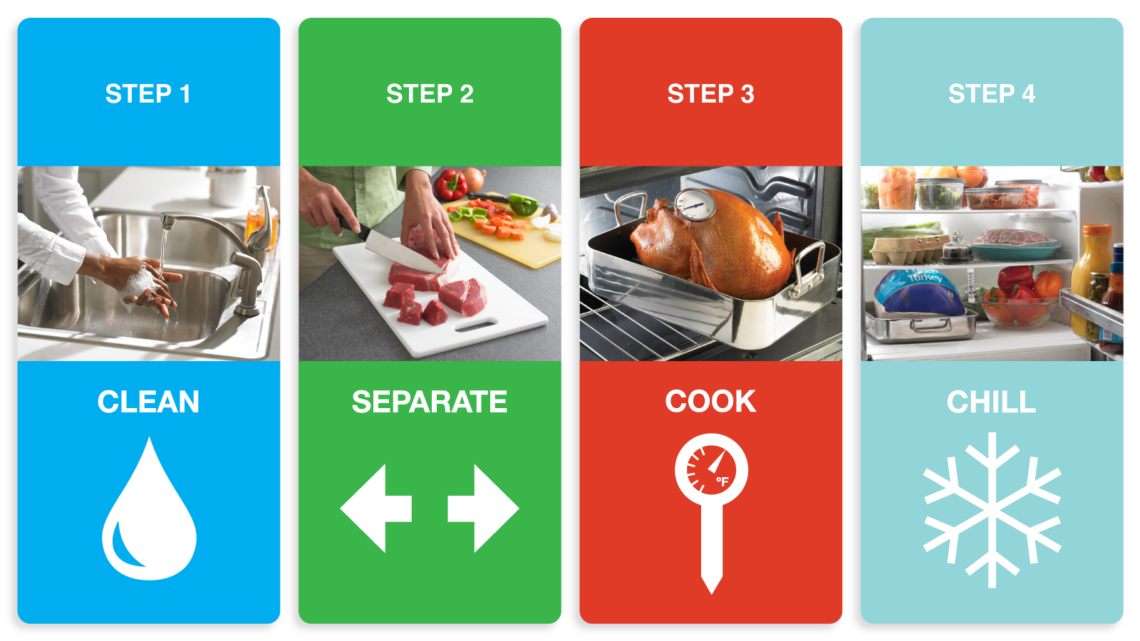
Safety in the kitchen is one of the most important things to consider in your house. Forty-eight million cases of foodborne illness occur each year — the equivalent of sickening 1 in 6 Americans. These illnesses result in an estimated 128,000 hospitalizations and 3,000 deaths. To prevent such occurrences, the United States Department of Agriculture has devised a simple formula to combat foodborne illnesses: Clean > Separate > Cook > Chill.
Clean
The first process in the clean step is to wash your hands. You want to soap up and wash your hands for at least 20 seconds before and after handling food, using the restroom, etc. It is important to wash your counters, pans, utensils and cutting boards with hot, soapy water before each use. When cleaning counters, think about using paper towels instead of regular kitchen towels to help prevent the spread of foodborne illness. If using kitchen towels, wash them frequently with hot water. Remember to wash all fruit and vegetables in running water. This includes fruits and vegetables with outer skins you do not eat. Rinse off the tops of canned goods before you open them.
Separate
Separate raw poultry, seafood and meat from other foods when shopping. Keep them separated from other foods in your refrigerator, as well. Use separate cutting boards: one for fresh fruits and vegetables and another one for raw meats. Immediately wash the cutting board for raw meat in hot water and soap. Make sure you don’t place cooked food on a plate or in a bowl that previously had poultry, seafood, eggs or raw meat in it. If you use a dish, make sure it has been cleaned with warm, soapy water first. Don’t reuse marinades that were previously used on raw foods until you heat them to a boil.
Cook
Use a food thermometer to ensure that all raw foods are cooked to the proper temperature and that the internal temperature is high enough to destroy harmful bacteria. Cook eggs until the whites and yolks are firm.
When cooking in a microwave, remember to stir the food, cover it, and rotate it to ensure it is cooked evenly. If the microwave has no turntable, rotate the food a couple of times during cooking. Allow standing time for the food that you have prepared in the microwave so that it can finish cooking. Then, check it with a food thermometer to ensure it is at the proper temperature.
When you are reheating soups, gravy or sauces, make sure you bring them to a boil. To ensure the appropriate temperature for your meats, look online for a “meat temperature chart.” This will pull up a chart that lists all the recommended temperatures for cooking meat. Use a food thermometer to ensure the food is at the right temperature.
Chill
Once the food has cooled, place it in the refrigerator or the freezer. Never leave perishables out on the counter for more than two hours. If the temperature is above 90º Fahrenheit, refrigerate or freeze no more than one hour after cooking.
Check the temperature of your refrigerator and freezer frequently. The refrigerator should be 40 degrees, and the freezer should be at zero.
Do not thaw food at room temperature. Instead, thaw food in the refrigerator, microwave or with cold water. Food thawed in the microwave or cold water should be chilled in the refrigerator or cooked immediately. When marinating food, do not leave it out on the countertop. Always put it in the refrigerator.
With the holidays approaching, there will be a lot more cooking. Following these simple steps, you can rest easy knowing you have a safe kitchen and ensure everyone remains happy and healthy.
Adrian Kohrt is a family nutrition coordinator for the Cooperative Extension Service, a part of the University of Alaska Fairbanks, which works in cooperation with the U.S. Department of Agriculture. For questions, she can be contacted at amkohrt@alaska.edu or 907-474-7930.
