By Gooseberry Peter
This may not seem like the most obvious time of year to think about invasive species. The cold, dark days of midwinter don’t immediately inspire images of introduced plants and animals spreading across the landscape.
While it is tempting to assume that invasive species are frozen in suspended animation for eight months out of the year (when they are really just out of sight and therefore out of mind), do not let the snow and ice fool you! Invasive species are highly mobile even in the depths of winter, and we should still take precautions to prevent their spread.
It is not uncommon in the spring to discover invasive species established in places they were not found the previous year. Invasive species rely on a variety of dispersal mechanisms to get around, many of which continue right through the winter months and are enabled by human activity.
Plant seeds are particularly adept winter travelers. They are often transported on animal fur or in straw bedding, on outdoor equipment, clothing and footwear, and via wind, snowplow and meltwater. Animals also continue to spread plant seeds in winter via the “dine and distribute” method, for example, by consuming seed-bearing material (like hay or chokecherries) in one location and then depositing seed-bearing byproducts in another location.
Plants are not the only organisms on the move in the winter. Forest pests, including insects and pathogens, can be transported on firewood or timber even in the winter. Aquatic invasive species can be transported on ice fishing gear.
Elodea is a great example. First detected in Interior Alaska a dozen or so years ago, this aquatic invasive plant poses a significant threat to local freshwater ecosystems and salmon habitat. Fast growing and extremely hardy, elodea continues to thrive under the icepack even in the dead of winter. It can reproduce from even tiny plant fragments, making it easy to transport to new locations. People ice fishing on elodea-infested lakes encounter it when it pops up through their fishing holes or gets tangled on their fishing tackle.
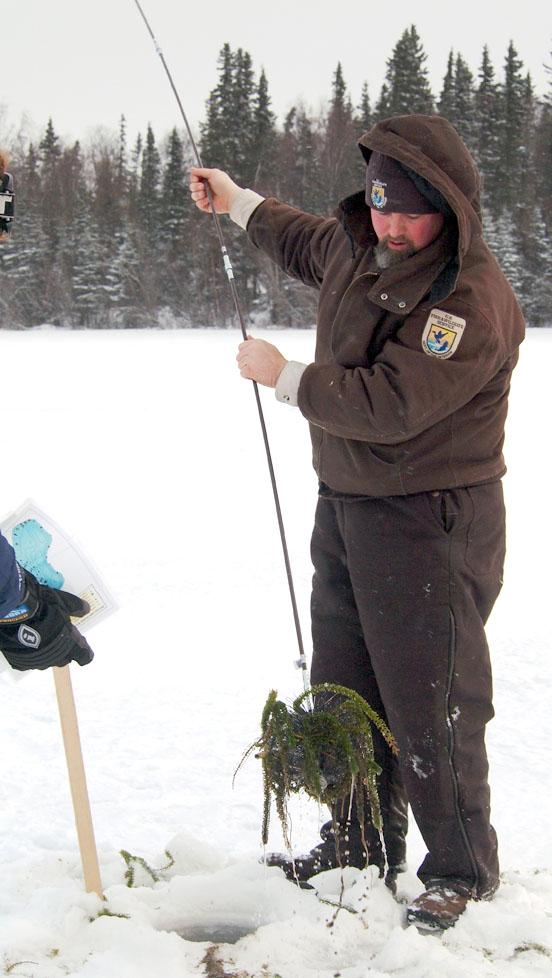
Photo by USFWS
Eradication efforts in the Interior began in 2017 and have been very successful. There are a few local waterbodies with known elodea infestations where management is ongoing, but new ones are still being discovered as the plant continues to get around.
Preventing the spread of invasive species is just as important in the winter as it is the rest of the year. Many of the same precautionary principles and practices apply in the cold and dark months as in the warm and bright months.
Inspect and clean all animals, outdoor equipment, clothing and footwear to remove potential invasive hitchhikers before you pack up to go home. Use locally grown, certified weed-free hay and straw whenever possible. Don’t transport firewood or timber far from where it was harvested unless it has been debarked and/or well-seasoned. Pay attention to invasive species signage and avoid areas with known infestations.
If you encounter invasive species, report them. To learn how, visit alaskainvasives.org and scroll over to the Report Invasive Species page.
Invasive species awareness needs to be a year-round effort. However we choose to experience the wonders of winter in the Interior (whether zipping down the trail with our sled dogs or snowmachines, cruising behind the wheel of the plow, or pulling fish out of the ice), we should always be mindful of the potential impacts. Taking just a few moments to pull any aquatic plant fragments off your ice auger before you leave the lake is just one example of a small action with a potentially huge impact. An ounce of prevention this winter may help reduce invasive species problems next summer and beyond.
Gooseberry Peter is the agriculture/integrated pest management program assistant for Cooperative Extension Service, a part of the University of Alaska Fairbanks, working in cooperation with the U.S. Department of Agriculture. For questions, he can be reached at gpeter3@alaska.edu or 907-474-6829.
