She has been with Extension in Alaska for 36 years, making her one of the longest-serving agents in Alaska Extension’s 90-year history.
Riley came to Anchorage in August 1984 as the newly hired “urban horticulturist.” She said, “My first week here frost killed the zucchini and I thought to myself, ‘What have I done?’ ”
Before coming to Alaska, the horticulturist had worked two years for a county Extension program in Wisconsin that encouraged the development of community gardens in inner-city Milwaukee.
She thought a lot of her work in Anchorage would focus on developing community gardens but discovered many already existed. Instead, she found what she calls a wave of interest in horticulture. “There was just this tremendous interest in gardening,” she said.
Riley spent 32 years in Anchorage, where she trained more than 1,500 Master Gardeners and advanced Master Gardeners, and, after transferring to Fairbanks in 2016, continued her work with farmers and gardeners.
In addition to training gardeners, she worked with organizations to develop community gardens at churches, elementary schools, housing units, etc. She was also interested in horticultural therapy, and worked with entities including the Salvation Army, Alaska Psychiatric Institute, the Anchorage Pioneers Home, the McLaughlin Youth Center and many other institutions.
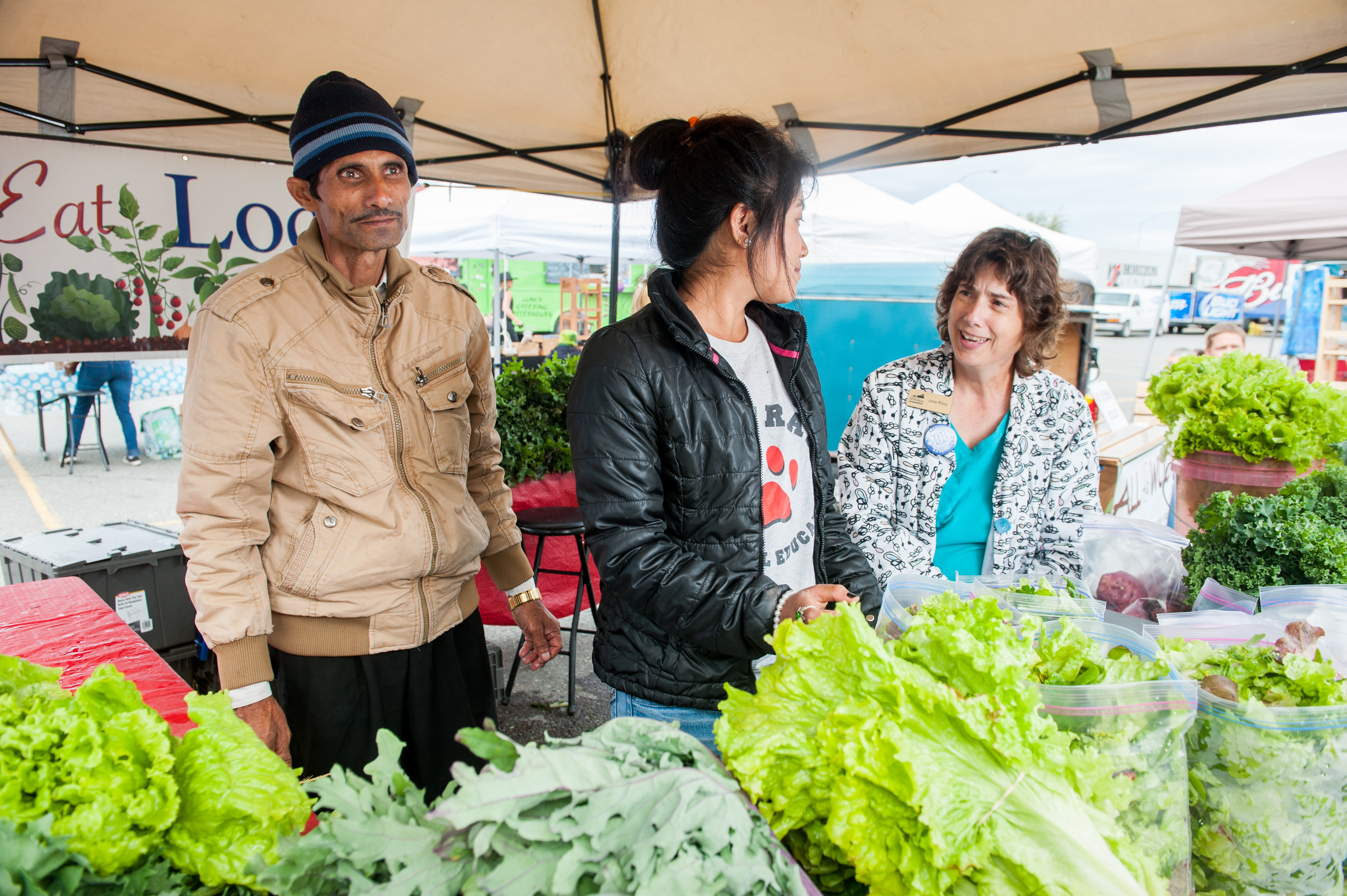
One of her best-known projects was a 10-year collaboration with Refugee Assistance and Immigration Services and Catholic Social Services. She coordinated the Refugee Farmers Market Project, providing horticultural and marketing education to Hmong, Bhutanese and West African refugees in Anchorage. They grew vegetables and herbs on city parkland and sold their produce at a farmers market. Sales reached an all-time high of more than $12,000, but it wasn’t about the money, she said. The project introduced refugees to new vegetables and gardening techniques and got them out interacting with others in the community.
She has developed a loyal following among Master Gardeners. Anchorage retiree Jane Baldwin said becoming a Master Gardener was on her bucket list when she signed up for the training in 1999.
“I really, thoroughly enjoyed it,” she said, Not only did she learn a lot more about gardening, she said, “It taught me how to find answers.”
Baldwin learned a lot about gardening and also found a community of like-minded people. She is the unofficial historian for the Anchorage Master Gardeners Association and has a whole new network of friends.
She said Julie was good at providing the training at a level people who were not grounded in science understood, and she was always accessible and approachable.
“She’s certainly got a heart of gold,” she said.
Riley also became interested and informed about peony production and worked with peony growers. She consulted with them as well as hosted workshops. She also participated regularly in the Anchorage Herb Study Group and Rose Society. She and another agent, Leslie Shallcross, hosted a Potato Bash several years to introduce consumers to more than two dozen specialty potatoes.
After coming to Fairbanks, she has become interested in insects because Fairbanks did not have an integrated pest management technician and she wanted to be better able to answer clients’ questions.
Riley has received many recognitions for her work, including the Achievement and Distinguished Service Awards from the National Association of County Agricultural Agents. The Refugee Assistance and Immigration Service gave her the Guiding Star Award on World Refugee Day for her work with refugees and Bhutanese gardeners honored her, along with the Municipality of Anchorage. The Anchorage Master Gardener Association gave her its Lifetime Achievement Award in 2019.
“Working for Extension has been my life,” Riley said. “It’s been a very satisfying career. I’ve learned so much. I learn something every day.”
One thing she learned from refugee gardeners is that gardening and your approach to it is based on what you grew up with.
“Over the years, I’ve been able to see that there’s more to gardening than just planting vegetables and flowers,” she says. She is also helping to develop leaders. Master Gardener training requires gardeners to complete 40 volunteer hours in the community, and she has encouraged Master Gardeners to become involved with gardener or master gardener associations as officers and to stay involved in their communities. Many have.
Reflecting on her retirement, she writes, “My retirement dream was to be dropped off on an atoll 1,400 miles northwest of Hawaii where I could pull invasive weeds for six months. I thought this would be the perfect way to decompress after working so long with the university, no Internet, no cell phone and 300 5-gallon buckets of food. Plus as a volunteer, I’d be helping to make Kure Atoll safer for seabirds who used the site UNESCO World Heritage Site for nesting.” Alas, she notes. She is not able to walk 10 miles a day and carry a 40-pound back.
She wants to learn more about insects and volunteer with Derek Sikes’ team at the University of Alaska Museum of the North.