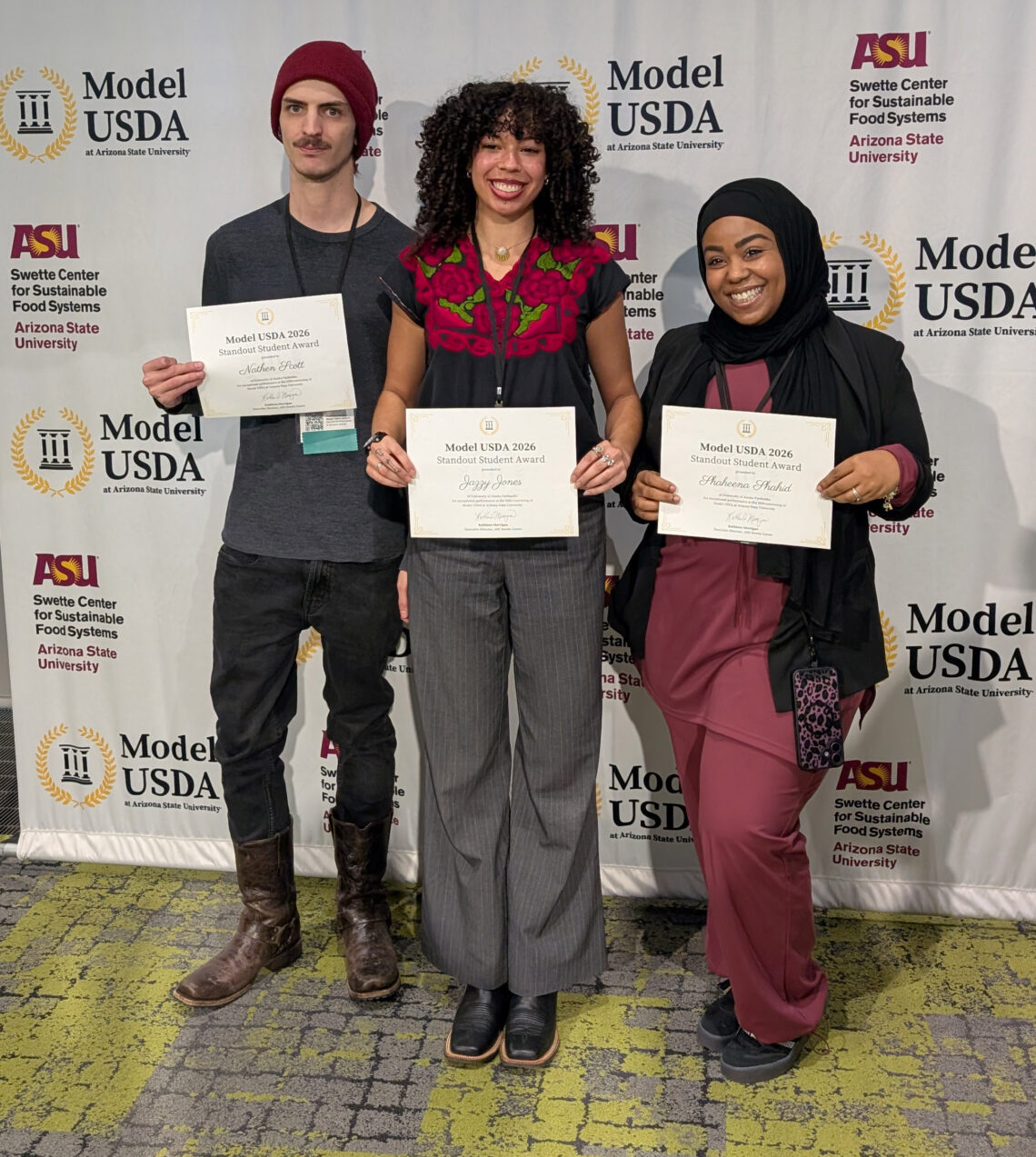
A 26-student NextGen delegation from the University of Alaska Fairbanks brought home top honors from Model USDA.
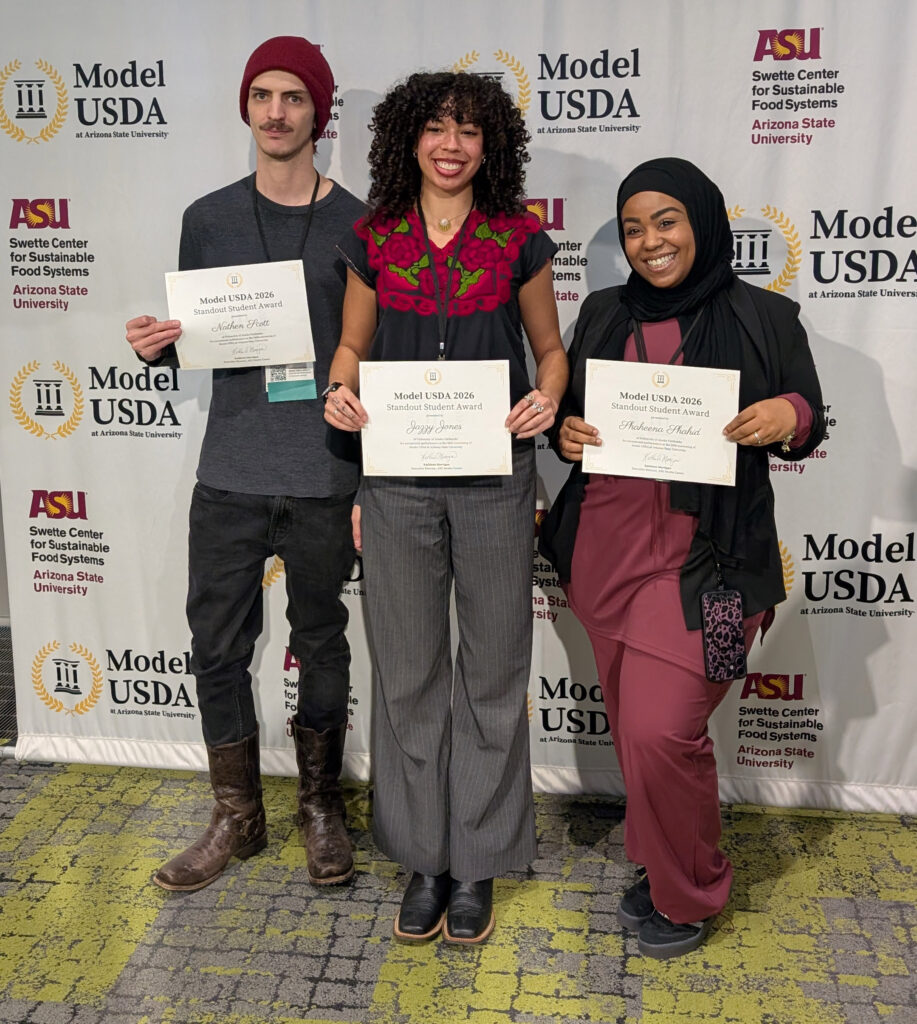
Supported by the U.S. Department of Agriculture NextGen initiative, Model USDA is a national effort to help students find food and agriculture careers. The 2026 program, held from Jan. 30-Feb. 1 at Arizona State University, included about 200 students from 31 institutions nationwide. Four UAF students earned “Standout Student” awards for leadership and policy expertise: Nathan Scott, Jazzy Jones, Shaheena Shahid and Hudson Bolduc.
“The NextGen program helped me realize that I can contribute beyond traditional farming,” Bolduc said.
Former USDA secretaries Dan Glickman and Ann Veneman served as mentors, highlighting the necessity of bipartisan cooperation in securing our national food systems. Read more about Model USDA in the Arizona State University newspaper.
Applications are now open for 2026 UAF NextGen scholarships and summer internships.
More information is available at the UAF NextGen website.
Here are observations from each of the four outstanding students. They were asked:
- On your career path: The NextGen program is designed to help you discover careers in food and agriculture. Before this event, what was your view of a career in agriculture, and how has this experience changed or sharpened your vision for your own future?
- On leadership: You were recognized for “diplomatic leadership” and bridge-building. Can you describe a specific moment during the simulation where you had to find common ground on a difficult policy issue?
- On the simulation: What was the most surprising thing you learned about how agricultural policy gets made behind the scenes?
- On the VIPs: What was the most impactful piece of advice you took away from former USDA secretaries or other presenters?
Nathan Scott:
- On your career path: I originally was considering working in a field of research into natural resource economics. Following this event, I realized how much I enjoyed participating in the challenges of decision-making. Playing Chief of Staff to the Secretary of Agriculture for the rural development scenario, I realized I am great at bringing parties to a solid set of final decisions that have a larger effect on general populations. This is when I realized that policy and decision-making is the field for me.
- On leadership: During my scenario, I had a few different instances that required me to find common ground. One topic that was requested by multiple parties was the development of infrastructure and resources for education. I realized that by connecting these individuals, they could find common ground for their proposal to the work group on how to allocate funding for infrastructure and educational development. This became one of the most prominently defined topics in the final budget proposal that was approved.
- On the simulation: I realized that agricultural policy doesn’t only include food production. Agricultural policy is the first step to building a community, because food security, water security, health care, and infrastructure are all included in the process to provide economic growth around agricultural businesses. This made me think about how each of these affects a community, and how to support that community, in turn, support food production and foundational business development.
- On the VIPs: One of my personally favorite speakers was past USDA Secretary of Agriculture Dan Glickman. One point that he made during his conversation and panel was that, in order to progress as a union, we all need to work together irregardless of our personal disagreements. He noted that he is Democratic and always has been, but he also noted that some of his closest colleagues were Republican. He stated that irregardless of the beliefs, they all had a goal on improving the quality of life for every American. Through this, he explained that he was happy to provide direction and received direction from both sides. This definitely resonated with me and continued into how I went about playing my role. I realize there will always be different points of view, but we are all hoping to build a better future for everyone.
Shaheena Shahid:
Before this event, the prevailing view of agriculture was that it was a dying industry because the average farmer was over 58. The only way to revitalize it and address major food fragility is to shift to heavily populated areas because this is where the exodus of rural areas are transitioning. We know that by 2050 most of the global population will live in cities, thus we should plan for this. This event reinforces that there shouldn’t be an urban-rural divide, but rather collaboration to create innovative solutions, given the multilayered effects on both communities.
In the simulation, we discussed financial priorities and food security because we originally wanted to address marginalized communities’ ability to access food. For me, urban agriculture is the response to climate change and intersects with my overall career goals. However, we were faced with a crisis that removed DEI and focused on specific initiatives to secure additional funding. This is actually the current climate, so I had everyone sit down and update our past policies to meet current expectations, without eliminating the focus in a way that the secretary and executive council could understand our intention and mission.
Our policies were:
- Food: Generating food using food methods such as hydroponics, aquaponics, vertical farms and community gardens
- Access: Working with universities and institutions to distribute educational resources to inform the youth and provide resources that support linguistic diversity and abilities
- Community: Serve marginalized communities in culturally affirming ways to teach them to live healthy lifestyles using food resources, to beome financially resilient and reduce food gaps
Our policies became:
1)Food: Generating food using food methods such as hydroponics, aquaponics, vertical farms, and community gardens
2)Obtainment: Provide educational resources to all to succeed in a metropolitan agricultural setting
3)Local Community: Provide opportunities to all stakeholders who seek it
Although the language shifted to align with the political regime, it meant the work halted; this is a real-world issue that transformed the U.S., and community members had to navigate their priorities while still supporting their communities.
It was interesting to learn that the last major bill passed was in 2018. By going through the simulation, I can understand why the approach is to handle things locally through the agency rather than going higher through Congress, which can have conflicting agendas and may cause delays.
Jazzy Jones:
Career: Before Model USDA, I held an immense respect for the producers who keep the populace fed, day in and day out. On a micro level, I’m aware of the need to be flexible and adaptive to supply chain constraints, transmissible illnesses, and market dynamics. On a mezzo level, I realized the value of scientific solutions and the potential for agrotechnology to soar. On a macro level, I got clarity on how careers (including my own) in research & policymaking ought to support the ag sector: Represent the hardworking ethics, champion knowledge-holders, and make decisions alongside cultivators of food and culture.
Leadership: Diplomacy, bridge-building, and leadership are direct results from an informed communications strategy. Knowing your audience, their heritage, means, motivations, and necessities is a starting point that gets neglected when “leaders” arrive with minds made up and a bias to be confirmed. My simulation group spent most of the first day with big ideas, conceptualizing ourselves into a vague draft budget with percentages– instead of plans.
One stakeholder raised her voice to advocate for temporary employee housing and protection of natural resources. Both had merit, but were broadly outside the bounds of our spending obligations. I was able to address the first request during Q&A by explaining that ancillary business development in rural communities can be designed to accommodate seasonal/temp workers with onsite and multipurpose dwellings.
To incorporate the natural resource target, I had to interpret the intent and create a sensible project. In creating the NRCS Climate-Smart Conservation of Rural America’s Grasslands, I offered a small vehicle fleet for combined use in remote locations– serving the purposes of soil sampling for carbon sequestration potential and a second-phase seed-to-soil native vegetation perimeter planting project (say that five times fast!).
The key to success was that I didn’t diminish the big idea, but I made it specific and to scale. With research, tact and refinement, I took it from long shot to line item.
Hudson Boldoc:
1: Before participating in the NextGen program, I largely envisioned my future in agriculture as becoming a farmer in rural Alaska, focusing on experimentation and sustainable growing practices. I currently operate a hydroponic farm in Ester and earned my bachelor’s degree in Horticulture Management, which reinforced my passion for hands-on food production and local food security. I was also fortunate to be part of a USDA cohort focused on the concept of ‘fighting fire with fire,’ which introduced me to the intersection of agriculture, land management, and wildfire mitigation.
This experience broadened my perspective on the diverse career pathways within food and agriculture. Over the past year, I researched wildland fire risk and insurance impacts in California, which deepened my understanding of how wildfire threatens agricultural systems, communities, and economic stability. The NextGen program helped me realize that I can contribute beyond traditional farming by working at the intersection of agriculture, wildfire risk reduction, and land stewardship. Moving forward, I am interested in identifying innovative ways to integrate sustainable agriculture practices with wildfire mitigation strategies to strengthen both food systems and landscape resilience.
4: Hearing former USDA Secretary Ann Veneman speak about being the first woman to hold leadership roles in agriculture and her commitment to opening doors for others was incredibly impactful. As a first-generation college student, navigating higher education has often felt challenging and unfamiliar. Her message reinforced the importance of persistence, networking, and building supportive communities. Through collaborating with other first-generation students and actively engaging in campus life, I’ve learned that there truly is a seat at the table for nontraditional students, and it is our responsibility to help create space for those who follow.
